
Amatsukaze
Standardizing Internal Tool and Data Integration — Introducing MCP-Based Integration Support
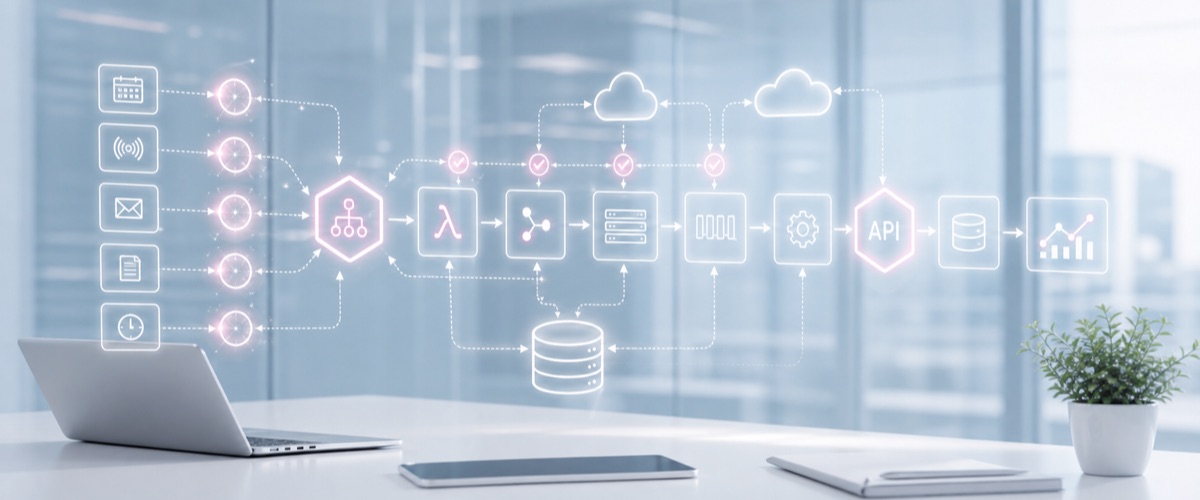
Amatsukaze Inc. has launched its support service for standardizing internal tool and data integration using MCP (Model Context Protocol), the industry standard. The service reorganizes the AI-to-internal-system integrations that tend to proliferate across departments into reusable, standardized interfaces, and provides end-to-end support spanning design, implementation, security, and operations.
The Current Landscape: The "M×N" Integration Problem and MCP as the De Facto Standard
As the business use of generative AI and agents accelerates, how to connect AI to internal tools and data has emerged as a new bottleneck. When you connect each AI application — chatbots, search, code generation, workflow automation — individually to systems such as your CRM, groupware, databases, and internal APIs, the number of integrations explodes as applications × tools (M×N). Rebuilding a connection to the same data source over and over for each use case quietly compounds development costs and ongoing maintenance burden.
The de facto answer to this problem is MCP (Model Context Protocol), the open standard Anthropic released in November 2024. MCP connects AI applications and external tools and data sources through a single standardized interface, and is often described as "USB-C for AI." Each application implements an MCP client once, and each tool exposes an MCP server once — reducing the M×N combinatorial explosion to M + N.
MCP was elevated to an industry standard with remarkable speed. Throughout 2025, OpenAI, Google, and Microsoft announced support one after another, and the major AI platforms adopted MCP as a shared integration foundation. On December 9, 2025, Anthropic donated MCP to the Agentic AI Foundation (AAIF) under the Linux Foundation, placing it under neutral, vendor-independent governance. With more than 10,000 public MCP servers now available, MCP is fast becoming the common language that enterprises assume when designing AI integrations.
Why Standardize Integration, and Why Now
The need to standardize internal AI integration is rising from three main angles.
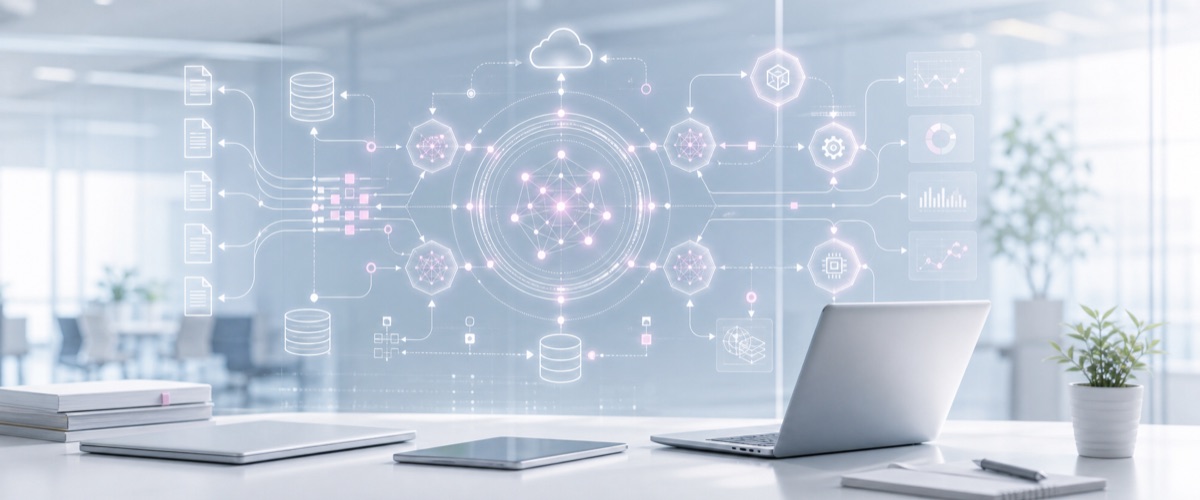
- Fragmentation and duplicated development: Each department and project builds its own connectors, so connections to the same system are duplicated many times over. Integrations that are not standardized create a state where, every time the maintainers change, no one can grasp the whole picture.
- Governance and security: Which data can the AI access, and what actions can it perform? Left as individual implementations, authentication, authorization, and auditing diverge connection by connection, and control breaks down. MCP-specific risks such as prompt injection and excessive privilege grants also demand cross-cutting safeguards.
- The need for standardization: Now that a common specification — MCP — has taken hold, it is the ideal moment to reorganize ad hoc connections into reusable, standardized interfaces. Converging on the standard also lets you adapt flexibly as future AI models and agents change.
In short, the challenge has shifted from "can we connect it?" to "how do we converge a sprawl of integrations into a controlled standard?" The longer standardization is deferred, the more bespoke integrations pile up — and the harder it becomes to untangle them later.
Expected Outcomes
Standardizing internal tool and data integration can deliver the following benefits.
- Less duplicate development: An integration published once as an MCP server can be reused by multiple AI applications and agents. You stop wasting effort rebuilding the same connection, and launching new AI use cases accelerates.
- Centralized governance: By consolidating authentication, authorization, and audit logs into the integration foundation, you can consistently control and trace which AI accessed which data and did what.
- Avoiding vendor lock-in: By conforming to a neutral standard, you stay free of any single model or platform and preserve your future options.
- Scalable extensibility: Adding a new tool becomes a matter of "adding one MCP server," after which it becomes available to all AI systems across the organization — so integrations accumulate as an organizational asset.
How We Make It Happen
Amatsukaze supports you in stages, from understanding the current landscape through deploying standardized interfaces.
- Inventorying current integrations: We catalog existing AI integrations, connectors, and APIs, surfacing duplication, key-person dependency, and security concerns, then prioritize what should be standardized.
- Designing and implementing MCP servers: We design and implement internal tools and data sources as MCP servers, publishing them as reusable, standardized interfaces.
- Security design for authentication, authorization, and auditing: We embed OAuth-based authentication, the principle of least privilege, and audit logging, establishing guardrails against risks such as prompt injection and excessive privilege grants.
- Connecting to existing agents / LLMs: We connect MCP servers to the LLMs, agents, and multi-agent orchestration platforms used in-house, shaping them into a form that works in real operations.
- Establishing standardization guidelines: We document naming conventions, authorization design, and publishing processes, putting in place operational rules that let teams expand integrations on their own.
Why Amatsukaze Is the Right Partner
Standardizing integration is not merely about writing MCP servers; success hinges on whether you can design robust infrastructure, AI engineering, and controlled operations as an integrated whole. Amatsukaze's strength is a structure that lets us work alongside you across all three.
- Robust infrastructure expertise: Drawing on knowledge cultivated through the design of high-load, high-transaction systems and the construction and operation of robust infrastructure, we design integration foundations that stay stable in real-world operation.
- AI / LLM engineering: We have hands-on capability with agentic AI, MCP, multi-agent orchestration, and AI governance (guardrails, evals, audit logs, and LLM observability), translating them into forms that deliver real business value.
- End-to-end partnership: We support everything from inventorying the current state through design, implementation, security, and operational rules under one roof. Rather than "connect and done," we work with you to build a mechanism in which the standard takes root in your organization and keeps generating value.
Move your internal AI integration to a controlled standard.
Go beyond one-off custom builds — talk to us about building an MCP-based integration foundation.